 WORLDTECH
Black hole jets may decide the fate of entire galaxies
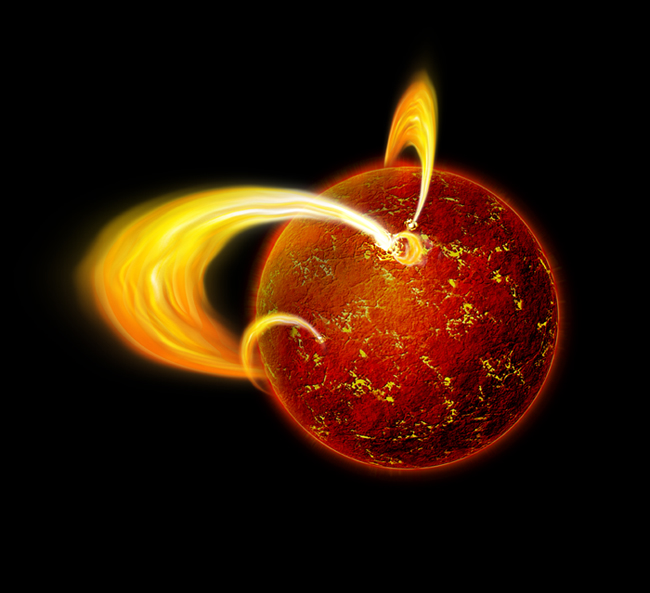
Full credit
File:Cosmic Blasts Much More Common, Astronomers Discover (2006-xrf).jpg / Illustration: NASA/CXC/M.Weiss / Cosmic Blasts Much More Common, Astronomers Discover / Wikimedia Commons / Public Domain / https://commons.wikimedia.org/wiki/File:Cosmic_Blasts_Much_More_Common,_Astronomers_Discover_(2006-xrf).jpgSource page.jpg)
What happened
Share: Facebook Twitter Pinterest LinkedIN Email FULL STORY Galaxies can contain hundreds of billions of stars, but every one of those stars begins with cold, dense gas. The CGM extends roughly 10-20 times farther than the visible part of a galaxy.
Powerful jets from supermassive black holes can disturb star-forming gas far beyond a galaxy’s visible edge, leaving a glowing trail hundreds of thousands of light-years long. Large galaxies, including the Milky Way, are surrounded by an enormous reservoir of this material known as the circumgalactic medium, or CGM.
Over time, some of this gas can cool, flow inward, gather into dense clouds, and eventually form new stars. Because stars give rise to planets and the conditions necessary for life, the CGM plays an important role in a galaxy's long term evolution.
Yet astronomers have faced a persistent puzzle. Something appears to be preventing much of that gas from cooling and falling inward. Black Hole Jets May Be the Missing Piece A new study led by astronomers Sanchayeeta Borthakur of Arizona State University (ASU) and Namrata Roy, now at the Raman Research Institute (RRI), offers evidence for one possible answer.
Sources & evidence
- ScienceDaily Reporting source
Black hole jets may decide the fate of entire galaxies ↗
https://www.sciencedaily.com/releases/2026/09/260928100527.htm