 WORLDTECH
Webb captures commotion from nebula’s stellar jets
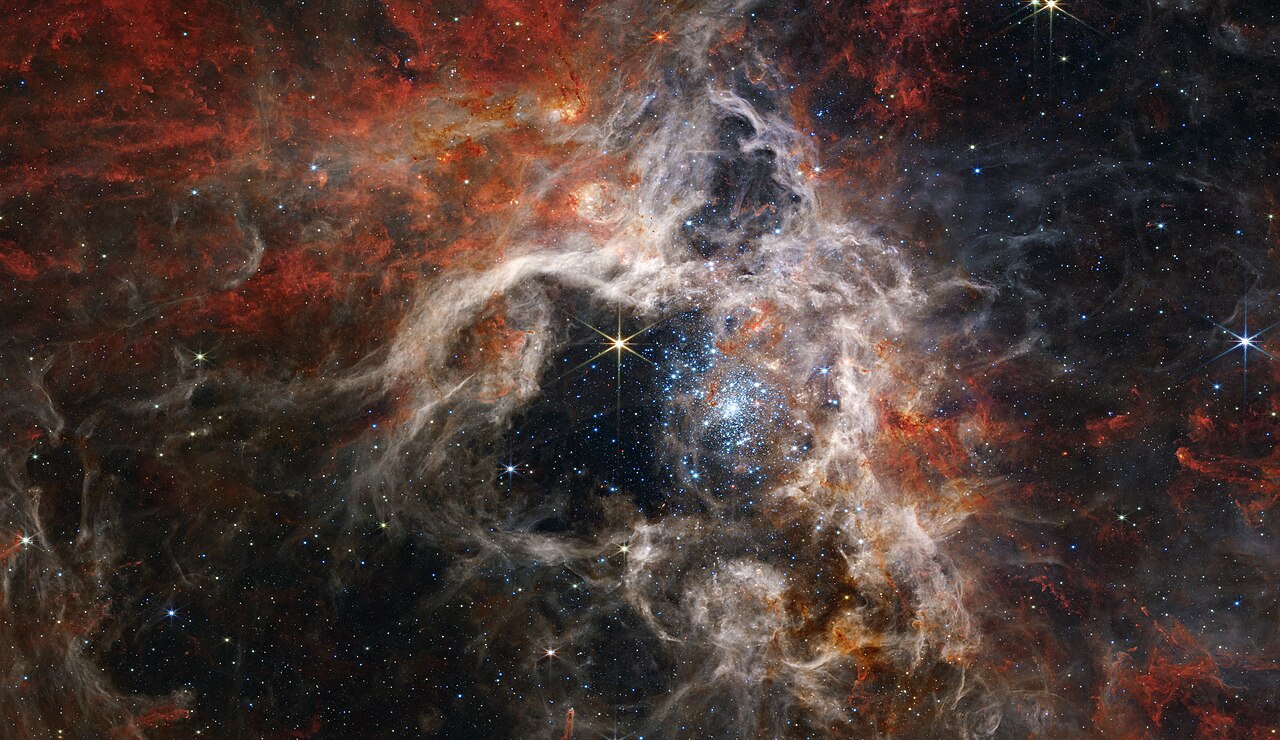
Full credit
File:Tarantula Nebula by JWST.jpg / NASA, ESA, CSA, STScI, Webb ERO Production Team / https://webbtelescope.org/contents/media/images/2022/041/01GA76MYFN0FMKNRHGCAGGYCVQ / Wikimedia Commons / Public Domain / https://commons.wikimedia.org/wiki/File:Tarantula_Nebula_by_JWST.jpgSource page
What happened
NASA/ESA/CSA James Webb Space Telescope has unveiled numerous stars formerly hidden by clouds of dust in a stellar nursery known as NGC 7129 – a cauldron of cosmic creation, 3300 light-years from Earth. Webb captured infrared light, which pierces through the dense matter that scatters or absorbs other types of light.
So-called pre-main-sequence stars like these have mostly finished gathering mass and have begun contracting under the force of gravity, causing their temperatures to rise. This region, rife with stellar objects in different stages of their lives, offers an opportunity to explore how stars shape their surroundings.
The stars from this cluster are in different stages of their development, as the more massive stars form and evolve the fastest. The most massive (and the most mature) is the region’s luminous central star, LkH(alpha) 234. The cavity to its left, which appears in gold and spans about 3.5 light-years, is the largest demonstration of the central star’s impact.
Sources & evidence
- European Space Agency Top News Primary / official
Webb captures commotion from nebula’s stellar jets ↗
https://www.esa.int/ESA_Multimedia/Images/2026/10/Webb_captures_commotion_from_nebula_s_stellar_jets - European Space Agency Primary / official
Webb captures commotion from nebula’s stellar jets ↗
https://www.esa.int/ESA_Multimedia/Images/2026/10/Webb_captures_commotion_from_nebula_s_stellar_jets